

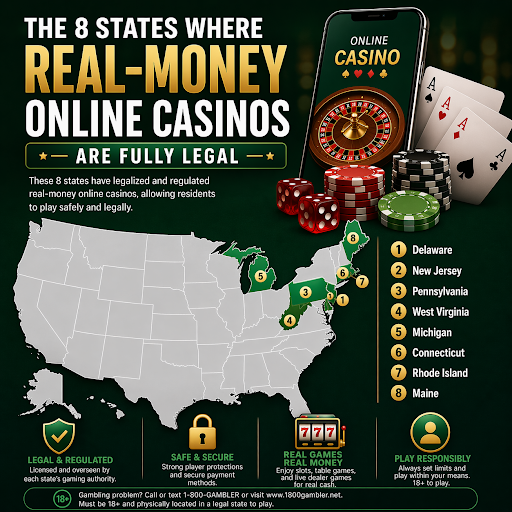
As of April 2026, 8 states have legalized real-money online casinos , 7 are fully live and operational right now, and Maine is the 8th, having passed legislation in January 2026 with a launch expected in late 2026 or early 2027.
State | Year Legalized | Went Live | What's legal |
Delaware | 2012 | Oct 2013 | Online slots, blackjack, roulette, video poker, online poker, and sports betting. |
New Jersey | 2013 | 2013/2018 | Real-money slots, table games, live dealer games, online poker, and sports betting |
Pennsylvania | 2017 | 2019 | Online slots, table games, live dealer games, online poker, sports betting, and online keno/lottery products. |
West Virginia | 2019 | 2020 | Online slots, table games, live dealer games, online poker, and sports betting. |
Michigan | 2019 | Jan 2021 | Online slots, table games, live dealer games, online poker, sports betting, and daily fantasy sports. |
Connecticut | May 2021 | Oct 2021 | Online slots, table games, live dealer games, online poker, sports betting, and state lottery products. |
Rhode Island | 2023 | Mar 2024 | Online slots, table games, online poker, sports betting, and lottery products. |
Maine | 2025–2026 | Mid-2026 (pending) | Real-money online slots, table games, online poker, and sports betting. |
The story of US online gambling really comes down to two landmark moments, and both are key to understanding is online casino legal in US today.
The first was in 2011, when the US Department of Justice reinterpreted the Wire Act of 1961, a Cold War-era law originally meant to crack down on illegal sports betting operations. The DOJ clarified that it applied only to sports betting, not to poker or casino games. That single opinion cracked open the door for states to start legalizing online gambling on their own terms.
The second was in 2018, when the Supreme Court struck down PASPA (the Professional and Amateur Sports Protection Act) in the landmark Murphy v. NCAA ruling. This dismantled the federal ban on state-sponsored sports betting, triggering a nationwide wave of gambling legislation that eventually extended beyond sports books into full online casinos.
Understanding is online casino legal in US helps players quickly identify where real-money online gambling is actually permitted, and which states allow full access to new online casino in USA platforms.
New Jersey didn't just get there first , it got there right. When NJ launched its online casino market in November 2013, it became the blueprint every state would eventually follow. More than a decade later, it remains the largest, most competitive, and most mature online casino in USA market in the entire country.
Who regulates it: The New Jersey Division of Gaming Enforcement (NJDGE) oversees all licensed operators. Every operator must partner with an Atlantic City land-based casino to receive a license, which keeps the physical casino industry tied into the digital economy.
Key Player Regulations in New Jersey:
New Jersey consistently generates over $200 million per month in combined iGaming revenue, and it's the market benchmark that lawmakers in other states point to when arguing for legalization.
Delaware doesn't get nearly enough credit. It was technically the first state in the US to go live with regulated online casino gambling, beating New Jersey by a matter of weeks in October 2013. The market is much smaller , Delaware has a population of under one million , but its regulatory model is interesting precisely because of how different it is from everywhere else.
Who regulates it: The Delaware Lottery runs a state-controlled monopoly model. There's no open operator marketplace here , the state itself manages online gambling through partnerships with its three land-based casinos. The technology is powered by 888 Holdings on the backend.
Who's operating: The Delaware Lottery (state-run), in partnership with the three best online casinos in the USA.
Key Player Regulations in Delaware
Pennsylvania made a statement in October 2017 when it passed the Gaming Expansion Act (Act 42) , one of the most sweeping gambling reform bills any state has ever passed. It took another two years for the regulatory framework to be built and the first sites to go live in mid-2019, but the wait was worth it. PA is now the second-largest online casino market in the country.
Who regulates it: The Pennsylvania Gaming Control Board (PGCB) licenses and monitors all operators. PA has a notably high tax rate on online slots , 54% , yet it still attracts 20+ operators because the player pool is large enough to make the numbers work.
Pennsylvania proved that a large, diverse operator market could thrive even under high tax conditions , and that lesson hasn't been lost on states currently weighing legalization.
Key Player Regulations in Pennsylvania
West Virginia did something significant in March 2019 when it passed HB 2934, the West Virginia Lottery Interactive Wagering Act: it became the first state outside the Northeast to legalize full online casino gaming. For an industry that had been geographically clustered, this was a big deal.
Who regulates it: The West Virginia Lottery Commission handles licensing. Operators must partner with one of the state's five licensed land-based casinos to receive a license.
The West Virginia market is smaller than PA or NJ by revenue, but it's growing. And its willingness to be an early mover outside the Northeast corridor gave other inland and southern states a model to look at.
Key Player Regulations in West Virginia
Michigan is arguably the most exciting online casino market in the US right now. After passing the Lawful Internet Gaming Act in December 2019, the state went live in January 2021 and has been climbing the revenue charts ever since. What makes Michigan unique is that both commercial and tribal casino operators can apply for online licenses , a dual-track system that no other state had previously attempted at this scale.
Who regulates it: The Michigan Gaming Control Board (MGCB) licenses and oversees commercial operators. Tribal operators are licensed through agreements with the MGCB and their respective tribal gaming commissions.
Michigan's inclusive licensing model , welcoming both commercial and tribal operators , is being studied closely by other states with large tribal gaming presences, like California and Florida.
Key Player Regulations in Michigan
Connecticut legalized online gambling in May 2021 and launched in October of the same year. The legislative path here was shaped entirely by the state's two powerful tribal gaming authorities , the Mashantucket Pequot Tribe (Foxwoods) and the Mohegan Tribe (Mohegan Sun). As a result, the law was written to protect their exclusivity.
Who regulates it: The Connecticut Department of Consumer Protection (DCP) oversees the market.
Connecticut is one of the most restricted markets in the country from a competition standpoint. Two operators means less choice, fewer promotions, and less competitive odds for players. But it's fully legal, it's regulated, and it works.
Key Player Regulations in Connecticut
Rhode Island is the most recent state to join the live online casino club, with legislation passing in June 2023 and real-money games going live in March 2024. Like Delaware and Connecticut before it, Rhode Island opted for a tightly controlled, state-managed approach.
Who regulates it: The Rhode Island Lottery manages the market under a state monopoly structure.
Rhode Island is the smallest state in the union by area, and its online casino market reflects that , it's small, controlled, and not particularly competitive. But for Rhode Island residents, it provides a safe, legal option that didn't exist before 2024.
Key Player Regulations in Maine
Maine is the newest addition to the legal online casino map , and it got there in an interesting way. Governor Janet Mills allowed LD 1164 to become law in January 2026 without her signature, making Maine the 8th US state to legalize real-money online casino gaming.
The Maine Gambling Control Unit is currently in the process of building out its regulatory framework and will issue up to four operator licenses. The law officially takes effect in July 2026, but realistically, live platforms aren't expected until late 2026 or early 2027 once licensing and technical compliance reviews are complete.
Who will regulate it: The Maine Gambling Control Unit.
Maine is a smaller market by population, but its legalization is symbolically important , it continues the steady northeast expansion of legal iGaming and keeps the momentum building toward larger states like New York and Illinois eventually following suit.
Key Player Regulations in Maine
Here's the irony that surprises most people: Nevada , home to Las Vegas, the gambling capital of the world , does not have legal online casino games. No online slots. No virtual blackjack. Nothing beyond poker and sports betting.
The reason is simple: Nevada's land-based casino industry is enormously powerful, and those operators have consistently lobbied against online casino legalization out of fear that it would cannibalize their floor traffic and revenue.
What IS legal in Nevada online:
Regulator: Nevada Gaming Control Board (NGCB)
Key Player Regulations in Nevada
Online gambling in the US isn't just shaped by state laws. Several federal statutes create the guardrails within which every state must operate. This is why the question is online casino legal in US cannot be answered with a simple yes or no at the national level, it always depends on how federal rules interact with state-level regulation.
These states have legalized online sports betting but have not extended legalization to full online casino games. Because of these restrictions, many players also start exploring digital alternatives such as crypto platforms and the best bitcoin casino in the USA, which often operate outside traditional banking limitations
State | Sports Betting Live Since | Online Casino? |
Arizona | 2021 | ❌ No |
Arkansas | 2022 | ❌ No |
Colorado | 2020 | ❌ No |
Florida | Tribal/Contested | ❌ No |
Illinois | 2020 | ❌ No |
Indiana | 2019 | ❌ No |
Iowa | 2019 | ❌ No |
Kansas | 2022 | ❌ No |
Kentucky | 2023 | ❌ No |
Louisiana | 2021 | ❌ No |
Maryland | 2022 | ❌ No |
Massachusetts | 2023 | ❌ No |
Missouri | 2025 | ❌ No |
New Hampshire | 2019 | ❌ No |
North Carolina | 2024 | ❌ No |
Ohio | 2023 | ❌ No |
Oregon | 2019 | ❌ No |
Tennessee | 2020 | ❌ No |
Vermont | 2024 | ❌ No |
Virginia | 2021 | ❌ No |
Wyoming | 2021 | ❌ No |
The map is almost certainly going to expand. Here are the states most actively working toward legalization right now:
The pattern is consistent: states with recent land-based casino investments tend to push back hardest against online legalization, fearing it will cut into physical casino revenues before those investments have fully paid off.
If you’re curious about online gambling but don’t want to risk money, free casino games in USA are the easiest way to get started. These games let players enjoy slots, blackjack, roulette, and poker in demo mode without making any deposit or creating a paid account.
The US online casino landscape in 2026 is a tale of two Americas. In seven states , New Jersey, Delaware, Pennsylvania, West Virginia, Michigan, Connecticut, and Rhode Island , adults can legally fire up a licensed app and play real-money casino games from anywhere within state lines. Maine is set to become the 8th operational market before the end of 2026 or into early 2027.
In the other 42 states, players either can't access real-money casinos at all, or they're limited to sweepstakes platforms and sports betting apps, which further reinforces why is online casino legal in US is still one of the most searched gambling questions online.
The market is moving. Slowly, state by state, the legal map is expanding. And with states like New York and Illinois potentially on the horizon, the next few years could bring the most significant shifts the industry has seen since New Jersey first went live back in 2013.